Widemann Recounts Journey Toward Developing First-Approved Treatment for NF1
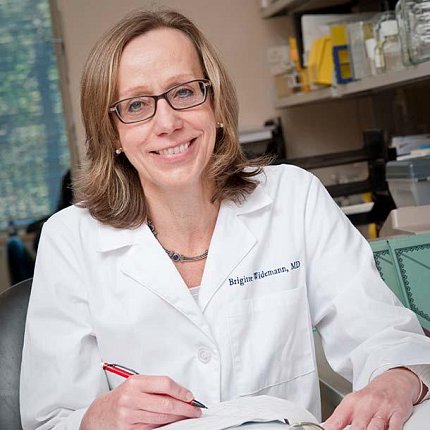
Five years ago, the Food and Drug Administration (FDA) approved selumetinib as the first-ever medical treatment for a rare condition called neurofibromatosis type 1 (NF1). This therapy wouldn’t have been possible without Dr. Brigitte Widemann’s research at the NIH Clinical Center.
“We were able to understand NF1 and, ultimately, come up with an effective treatment because we were able to learn from patients coming from all over the country to participate in clinical trials at NIH,” said Widemann, a pediatric oncologist at NIH’s National Cancer Institute.
NF1 occurs in approximately 1 in 3,000 people. About half of these patients will also develop tumors that grow along nerves called plexiform neurofibromas. The tumors can grow quickly and become very large. While these tumors are not cancerous, they can be disfiguring and painful and transform to become cancers. Surgical removal is often impossible because the tumors can be intertwined with nerves, blood vessels and tissue.
The disorder is caused by mutations in the NF1 gene that codes for the protein neurofibromin. Neurofibromin is important in the signaling pathway called RAS. This pathway regulates cellular growth and development. In patients with NF1, RAS is overly active in tumor cells, which causing cells to grow uncontrollably.
Widemann started her career as a first-year fellow in pediatric hematology oncology in 1992. She chose to join the Pediatric Branch of the NCI for her fellowship because she could both care for patients and conduct research.
“I knew from the beginning my goal was to develop better treatments for kids with cancers,” she said.
When she started working at NIH, researchers were starting to develop drug candidates to target RAS mutations. Although these drugs didn’t work well against cancers, Widemann thought these drugs might be effective treatments for NF1 plexiform neurofibromas.
Widemann and her team have been studying NF1 for more than two decades. When they first started their natural history studies, no one knew how fast tumors grew, when they grew or if they ever shrunk on their own. And there were no effective treatments.
In the years since, they’ve a learned a lot about the growth patterns of plexiform neurofibromas. Widemann uses a method called “volumetric analysis” to measure tumor size, which allows her to precisely track a tumor’s growth over time. They also tested patients’ pain levels, hearing and physical abilities, and cognitive function.
“In the natural history study, we brought kids to the Clinical Center every four months to get an MRI,” she said. “We learned tumors grow the fastest in young kids. In fact, they never shrink in kids. As they get older, tumor growth slows down and sometimes the tumors start shrinking a little bit by themselves.”
Now that there was a target and a way to measure a drug’s effectiveness, Widemann’s lab started enrolling pediatric patients with inoperable tumors in clinical trials. They tested several candidate drugs over the years. None of them shrunk or delayed tumor growth.
After years of testing, Widemann and her colleagues decided to test selumetinib, a drug that blocks a protein in a RAS pathway called MEK. Selumetinib was originally created to treat melanoma, pancreatic cancer, colorectal cancer and non-small cell lung cancer.
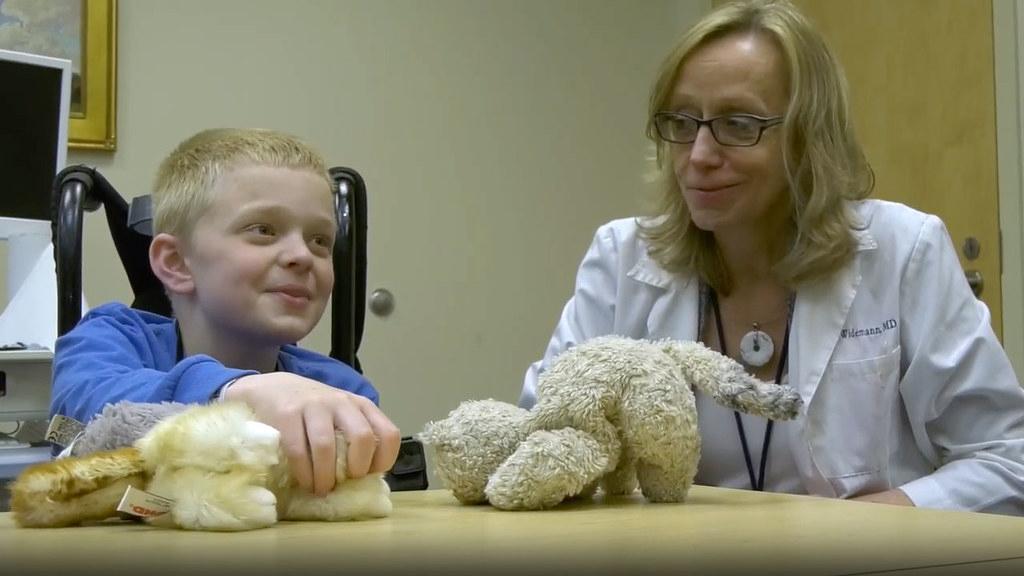
Photo: NCI
The first studies of the drug were designed to find the correct dose of the treatment. After four months, the first patient who received selumetinib came back to the Clinical Center for a follow-up appointment.
When reviewing imaging scans of the tumor, Widemann noticed its size decreased. At first, she thought it was a fluke. In almost a decade of research, she never saw that occur. Then, Widemann saw it happen again.
“I then knew this wasn’t a coincidence. It didn’t happen by chance,” she said. “This was the first time that we ever had a medicine that stopped the growth and shrank the tumors. It was really, really exciting.”
Building on their initial success, she and her colleagues launched a larger clinical trial. Selumetinib shrank the tumors in 70% of participants and most of the tumors didn’t grow again for more than a year.
Based on the findings from the study, the FDA approved selumetinib for children two years and older with NF1 and symptomatic, inoperable plexiform neurofibromas.
Before there was an effective treatment, Widemann and her colleagues informally met with the FDA reviewers about designing clinical trials. Proving clinical benefit for drugs that target rare diseases presents unique challenges to researchers.
Traditional clinical trial endpoints focus on measurable, clinically meaningful outcomes such as survival. Fortunately, many children who have NF1 grow up to be adults so survival couldn’t be an endpoint. Widemann developed alternative endpoints based off data from NF1 natural history studies. The reviewers could compare new findings with those from kids who weren’t treated with selumetinib.
“I enjoyed working with the FDA. I was very impressed by their rigor,” she said. “They understood they weren’t dealing with straightforward standard populations.”
Obtaining FDA approval was a group effort. Members of industry, NCI, the institute’s Cancer Therapy Evaluation Program, academic institutions and hospitals worked with patients, doctors, nurse practitioners and patient care coordinators and patient advocacy organizations. Patients, in particular, are central to the process. Some participated in six or seven clinical trials. They were committed to not only helping themselves, but others who might benefit in the future.
Although there’s now an FDA-approved drug to treat NF1, Widemann’s work continues.
“Ideally, I would like a drug that prevents the tumors from even establishing or from transforming to become more aggressive tumors,” she said.” There’s lots of work that still needs to be done to identify better treatments.”
Widemann is also applying the lessons she learned from NF1 to develop therapies for other childhood cancers and tumor-causing genetic disorders for which there are no effective treatments. Some of the diseases are so rare there are only 20 or 30 diagnoses per year in the United States.
This research would be difficult to conduct anywhere else, said Widemann. “The NIH Clinical Center is an exceptional place, where so many people are highly committed to science and research.”