
Persevering for a Treatment
At Long Last, Drug to Treat AKU Gets Approved

Dr. Wendy Introne was not giving up. Despite initially disappointing study data, she knew a particular drug would work. The biochemical results were robust. It had to work. Now, 15 years after the small clinical trial, the drug in question was finally approved to treat the rare disease she studies.
Introne leads a team that studies alkaptonuria (AKU), a genetic, degenerative metabolic disease. In people with AKU, the body cannot fully break down an amino acid called tyrosine, which causes homogentisic acid (HGA) to accumulate.
“HGA is the culprit substance that binds to collagen and connective tissue and causes the damage we see,” said Introne, a pediatrician who is a clinical and biochemical geneticist at NIH’s National Human Genome Research Institute.
Degrading tyrosine is a multi-step process. In AKU, the third enzyme in the process is deficient. The one sign present from birth is black urine, due to the buildup of HGA that is excreted in the urine. When patients turn about 30, Introne explained, they begin to see other symptoms, notably musculoskeletal problems and joint damage that are extremely painful.

“But these patients are remarkably resilient,” Introne said. “It’s incredible to see the level of degeneration of their spine and joints and how they really continue to persevere despite all of that.”
Other symptoms include aortic stenosis, due to HGA deposits in cardiac valves, as well as kidney and prostate stones.
About 30 years ago, an unlikely compound began to be tested for a related rare disorder. The drug, nitisinone, was initially developed for the agricultural industry given its herbicide qualities. As toxicologists in England studied this drug to uncover its mechanism of action, they observed it inhibited the second enzyme in the tyrosine-breakdown process.
The toxicologists alerted researchers who were studying hereditary tyrosinemia type 1 (HT1)—in which a different enzyme in the tyrosine degradation pathway is deficient—about this finding. A decade later, nitisinone was approved to treat HT1.
“It completely revolutionized care of those individuals,” Introne noted. “That’s when we said we think this drug would be really helpful for AKU, because [the deficiency] is in the same pathway.”
After acquiring permission to test nitisinone in their patients, Introne and colleagues launched a small clinical trial with 40 volunteers from 2005 to 2009 but despite dramatic biochemical results, the clinical results then weren’t encouraging. Their primary outcome parameter did not prove clinical benefit.
The journey toward approval was fraught with challenges. As with any rare disease study, they were encumbered by the small number of patients in the trial.
Also, in this case, “AKU is a disease that progresses over decades so trying to identify a change that is measurable during a three-year clinical trial period is really difficult,” Introne said. In addition, not everyone with AKU starts the same way or progresses on the exact same timeline.
“When you’re trying to find something for a cohort that’s changing, it’s hard to identify just one measure that captures the entire cohort of patients,” said Introne.
In the end, the answers they sought were in the original data. They knew a 2 mg dose of nitisinone reduced production of HGA by 95%. But they still had to link lower HGA to improved quality of life. The team kept looking, questioning and re-analyzing their data.
“We took a step back and looked at other objective numbers we could measure, such as cardiac function and radiographic changes,” she said. “And some of this was the Food and Drug Administration (FDA) coming around to say they’re interested in knowing how patients feel and function.”
And they found plenty of evidence in the patient-reported outcomes from the initial trial.
“We saw statistically significant gains in their physical function and in their energy,” as well as reduced pain levels, Introne said. “We saw improvements in terms of their activities, of daily living [after] starting the drug, and improvements in distance they’re able to walk.”
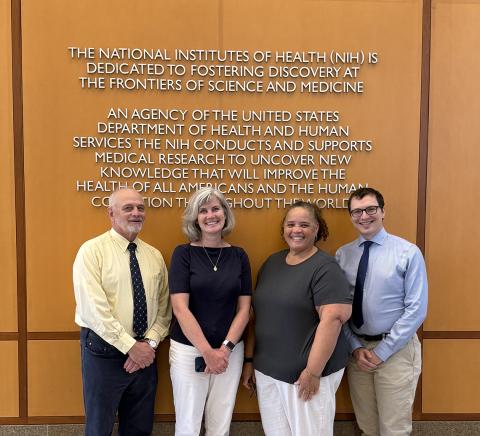
Ultimately, persistence paid off. Introne’s team submitted these measurable changes. “That was what convinced the FDA,” she said. In June, the FDA approved nitisinone to treat AKU.
Introne’s initial inspiration for studying AKU came from Dr. William Gahl, a senior investigator in the Medical Genetics Branch who runs NIH’s Undiagnosed Diseases Program. Introne first met Gahl in 1998 when she arrived at NIH for a genetics fellowship. Gahl, her fellowship adviser, told her about a potential medication for a disease called AKU but first they needed to learn more about the disease.
Together, she and Gahl launched a natural history study for AKU and she soon began meeting with patients in the local area. “That was it. I was hooked,” she said. “I’ve been really lucky because the patients are so dedicated.”
In the early days, the first question was whether nitisinone, an herbicide, would be safe to consume.
“I think back to what a leap of faith [the study participants with HT-1] must have had in those investigators and that this medication would be safe for them,” said Introne. “We had the advantage of already more than a decade of experience with nitisinone before we began giving it to our patients, because we knew how well-tolerated it was in the children who first tested it [for HT1].”
And it’s the younger people, those who don’t have symptoms yet, who stand to benefit the most from nitisinone. For them, the drug could be preventive.
“I have to sing the praises of all our patients who were so committed to this,” she said, “because so many adults have told me, ‘This medication may not change my life, but I really hope it will change the lives of young people with this disease.’”
Getting FDA approval of this treatment for AKU was a long time coming. “Sometimes the journey is not straightforward. Sometimes we have to be creative in how we get to the final endpoint,” Introne said. “If you believe in it, just keep going. The biggest thing is to persevere.”