Meet the NIH K9 Police Force
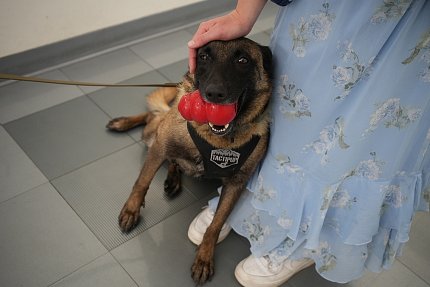
Photo: Eric Bock
The NIH community is “fur-tunate” to have its very own canine (K9) police unit dedicated to keeping campus safe.
Established in the early 1990s, the program started out with three patrol dogs and has since expanded significantly. The current-day unit comprises 10 K9-officer teams, with nine pairs based on main campus in Bethesda, Md. and one at Rocky Mountain Laboratories in Hamilton, Mont.
The original unit was designed for an open-campus environment, but when main campus was fenced in following 9/11, the K9 program pivoted to focus on explosives detection. The NIH K9s now mainly seek to combat the threat of explosives, firearms and other incendiary devices. On main campus, K9 units split their time between routine inspections and daily training exercises.
For K9 handlers, the work does not end when their shift ends.
“Having a dog means working 24/7,” said Sgt. Jose Ayala. His partner, Canela, a five-year-old female Belgian Malinois, spends nearly every waking hour with him; she has a dog bed in his office. NIH police dogs live full-time with their handlers and families and can even co-exist with other pets given the proper introductions.
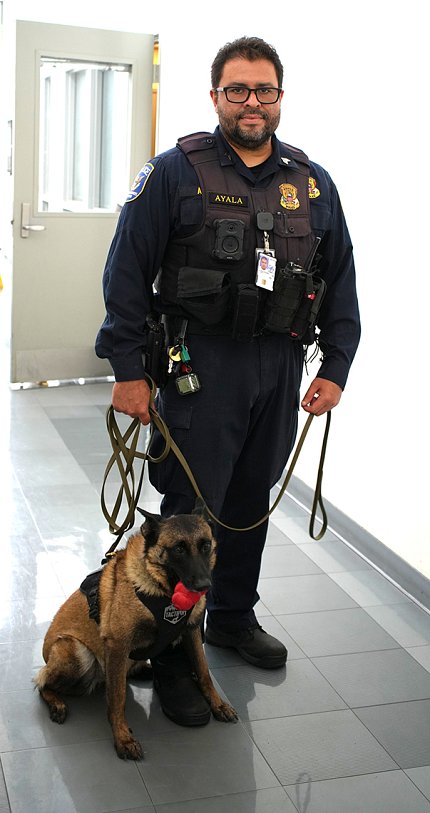
Photo: Eric Bock
In a typical day, K9 units work for three to four hours performing routine inspections. To keep the dogs fresh, they spend about 30 minutes working and then rest for 30 minutes. The handlers direct the dogs to carefully inspect vehicles that come through inspection locations—everything from lab supply deliveries to food trucks. The dogs sort through a huge array of distracting scents, like food or roadkill, to detect trace incendiary materials. On a typical day, one team will inspect between 60 and 100 vehicles.
The most common items canine teams find are firearms, said Ayala. Because NIH is considered federal property, visitors must comply with the rules that apply to federal facilities (which prohibit firearms), rather than wherever they are traveling from.
Ayala personally selects all police canines that come to work at NIH. The dogs, which are typically German Shepherds, Belgian Malinois or a mixture of one or both breeds, are bred in Europe and then travel to a vendor facility in North Carolina where they receive initial training. Once Ayala has selected the dogs, they go through an additional 15 weeks of training: 12 weeks in explosives detection (ED), and three more weeks with their new NIH canine officer.
New K9 handlers are typically sourced from within NIH’s own police department, Ayala said. “Effective verbal and non-verbal communication skills are essential for working as a team … [and] understanding canine behavior is crucial for interpreting subtle cues from the dog.”
The dogs will sit and stare once they have pinpointed a scent, but the tracking process can be complicated. Scent may travel and pool in various ways depending on environmental conditions. Air flow, interstitial spaces and other building quirks can make a scent flow differently, said Ayala, and handlers must be able to adjust for these factors. Regular training exercises—at least four hours per week—ensure the canine teams are at the top of their game.
“It’s teamwork, not a metal detector,” said Ayala. He and several canine teams demonstrated this teamwork recently in a series of training exercises at the Commercial Vehicle Inspection Facility (CVIF), conducting vehicle searches and an indoor search. The dogs sniffed along the line of incoming traffic and then moved onto a training exercise set up by Ayala, where they had to detect a training aid under the hood of a parked car. In the final trial, the dogs inspected the central hallway of the CVIF to find another training aid.

Photo: Eric Bock
Each canine team has their own methods for searching. Two intensely focused young Belgian Malinois, Jaco and Turbo, searched vehicles almost independently. Rocko, a black Dutch Shepherd/Belgian Malinois mix who partnered with Master Police Officer Alvin Maker, preferred more frequent verbal directions from his handler.
Turbo, one of the newest dogs on the unit handled by Corporal Fady Zaki, was still learning to navigate the slippery floor inside the CVIF, so Ayala conducted the final indoor search with his own petite “mini-Mal” Canela.
All four dogs had a brief play session with a sturdy toy after a successful search. Rocko particularly enjoyed exuberant verbal praise, while Jaco showed his excitement by standing on his hind legs to “hug” his partner, Corporal Alexander McPartland.
Ayala is looking to add more dogs to the unit, citing increased construction traffic at another NIH campus requiring a K9 team’s presence there. Facility expansions are also in the works on main campus. These changes will benefit both the K9 unit and the greater NIH community, Ayala said. “We work diligently to keep our community safe, ensuring everyone can be secure knowing their safety is our top priority.”
Photo Gallery


