‘Cascade of Care’
Bhattacharya Interviews Volkow in New Podcast

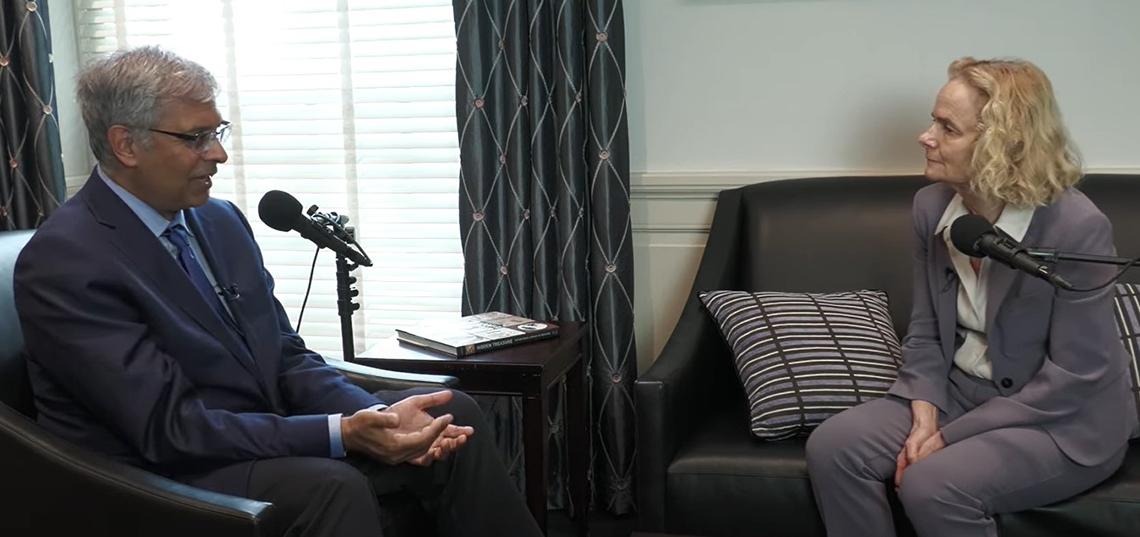
“I love data. I love being in the laboratory,” said Dr. Nora Volkow, director of NIH’s National Institute on Drug Abuse, in her discussion with NIH Director Dr. Jay Bhattacharya. The two colleagues chatted for 45 minutes in June on Bhattacharya’s new bi-weekly podcast, the Director’s Desk. The series is publicly available on YouTube.
The Director’s Desk podcast series explores groundbreaking work in conversations with people driving innovation in biomedical research and public health.
In their discussion, Volkow expounded on the root causes of drug addiction, the opioid crisis and NIDA research that’s shaping drug prevention and treatment efforts.
Volkow is a psychiatrist who began studying addiction while finishing her medical residency, during which she used imaging to see how drugs affect different areas of the brain. People who become addicted, she said, lose their ability to self-regulate.
“Drugs hijack the main motivational circuit that we have in our brains…that drives our actions,” she explained. Research combats the myth that using drugs when you are addicted is a choice. Rather, addiction is a brain disease linked with specific functional and neurochemical changes in the brain. Like other diseases, addiction is a product of biology and our environment.
Volkow candidly shared that there’s a history of alcohol use disorder in her family. “But I have always had multiple alternative reinforcers and a very supportive social environment,” she said, “that gave me resilience to counteract my genetic risk.”
The conversation also focused on responding to the opioid crisis. Bhattacharya recounted hearing in the early days, in the 1990s while he was still in medical school, about new opioids to treat pain that were touted as nonaddictive.
“I was struck by this,” he said. “You enter medicine because you want to help people who are in pain, and help people with disease. There was goodwill around this. But it turned out the drugs were quite addictive.”
Volkow concurred. “This is a perfect example of the negative consequences of the health care system having neglected addiction as a disease,” she said. Doctors and medical students were not trained on their management, she added, and could not recognize when their patients were becoming addicted.
It also illustrates how clinical practice can be influenced by limited scientific evidence—in this case a small study published in the New England Journal of Medicine—incorrectly concluding that opioids were not addictive when given to pain patients. Bhattacharya said this underscores the need for verification and replication in research.
Opioids play a role in treating severe acute pain, noted Volkow, but this article made clinicians overconfident and they started to prescribe them for moderate, lesser pain while alternative pain medications went underutilized. “We in the scientific field need to provide data that is robust and, as scientists, we should be able to question models and assumptions,” she said.
Volkow said a “cascade of care” is needed to help prevent addiction and facilitate its treatment and recovery. One of NIDA’s main efforts to combat drug overdose fatalities has been to determine how to increase the distribution and access to naloxone and to develop more user-friendly versions of this life-saving drug.
Volkow went on to explain how naloxone works. Opioids bind to receptors in brain centers that control respiration. When a person overdoses on opioids, they typically stop breathing, lose consciousness and, if not treated, they die.
“Naloxone gets in the brain immediately,” she said. “It removes the opioid from the receptor, breathing returns and [naloxone] saves a life. It’s almost magical, if you give it in time at the correct dose.”
Volkow also discussed the NIH-wide HEAL (Helping to End Addiction Long-term®) initiative, through which NIH has greatly expanded research on addiction and pain. Under HEAL, NIH has made a major investment in research to facilitate implementation of evidence-based addiction screening, prevention and treatment interventions in health care, justice and community settings and to accelerate the development of new therapeutics.
Addiction is a condition of the brain, summarized Bhattacharya. How the brain reacts to drugs and the social context in which a person lives are interconnected and critical to preventing and overcoming addiction.
Family and other community support bolsters resilience, Volkow underscored. In combatting addiction, she said: “What we need to address as a society is what we can do to strengthen those social networks that are so necessary to prevent it.”
To watch this and other episodes of the podcast, see: https://bit.ly/40GpHuE.