NIH Demystifies Vital Biomedical Tech for Congressional Staff

Photo: Marleen Van Den Neste
At NIH, biomedical engineers and imaging researchers gave 45 visitors from Capitol Hill a glimpse of transformative medical technologies on the horizon, underscoring the crucial role of medical tools in human health.
“There is no discovery in cancer, heart disease, metabolic disease—you name it—without advances in technology,” said Dr. Bruce Tromberg, director of NIH’s National Institute of Biomedical Imaging and Bioengineering (NIBIB). “To see things that haven’t been seen before, to develop understanding that hasn’t been developed before, and then to practically improve patients’ lives, it is a necessity.”
During the high-tech show-and-tell, held on July 18, congressional staff met with six research teams whose projects pit advanced technologies against a broad range of medical challenges. Several of these groups are using NIBIB’s support to ensure that biomedical technologies will benefit from recent advances in computing power, data acquisition and artificial intelligence (AI).

Photo: Marleen Van Den Neste
At the University of Chicago, Dr. Maryellen Giger and her colleagues have developed AI-powered software to distinguish benign from cancerous breast tumors in magnetic resonance images. Giger explained that this work led to the first FDA-approved software to aid breast cancer diagnosis, called QuantX, and how the group is extending their approach to thyroid cancer and traumatic brain injury.
To unlock the secrets of how cancer, Alzheimer’s disease and other conditions manifest, Dr. Harshad Vishwasrao is thinking outside of the traditional imaging toolbox. At NIBIB’s Advanced Imaging and Microscopy (AIM) resource, he is helping scientists answer pressing questions with powerful prototype microscopes capable of building complex 3D maps of the brain. AIM is also developing AI tools to analyze these enormous maps.
Researchers from the University of California, Irvine are collecting an abundance of data as well, with tiny wearable sensors. Dr. Elliot Botvinick likened the team’s device, named LifeStrip, to continuous glucose monitors—commonly used by people with diabetes—but differing in its ability to simultaneously measure up to 10 biomarkers at once. When time is of the essence, this tech could provide life-saving insight into conditions such as severe trauma, diabetic ketoacidosis or heart attack.

Photo: Marleen Van Den Neste
Just as engineers can program computers with precision, Dr. Ahmad Khalil at Boston University is manipulating genetic circuitry to reprogram biological systems. At the center of his effort is eVOLVER, an open-source platform that simulates the process of evolution at an accelerated rate to produce custom-tailored proteins and cells.
Khalil said the technology, now in use at dozens of institutions across the U.S., could sharpen the precision of genome editing and bolster the safety of cancer immunotherapies.
At the event, congressional staffers shook hands with more than just researchers. Dr. Nancy Pollard and her team from Carnegie Mellon University introduced visitors to a robotic hand with a softer touch than most existing prosthetics. They are developing the lightweight foam hand to offer people with limb loss greater dexterity than traditional devices, helping them accomplish everyday tasks such as grasping a pen or washcloth.

Photo: Marleen Van Den Neste
Dr. Manu Platt, who helms NIBIB’s Center for Biomedical Engineering Technology Acceleration (BETA Center), emphasized to staffers the importance of not only technology, but also the training and guidance needed to use it effectively. The BETA Center offers top-flight technical expertise and resources, encompassing 3D printers, computational models and customized biomaterials, to empower the NIH research community through custom-made solutions.
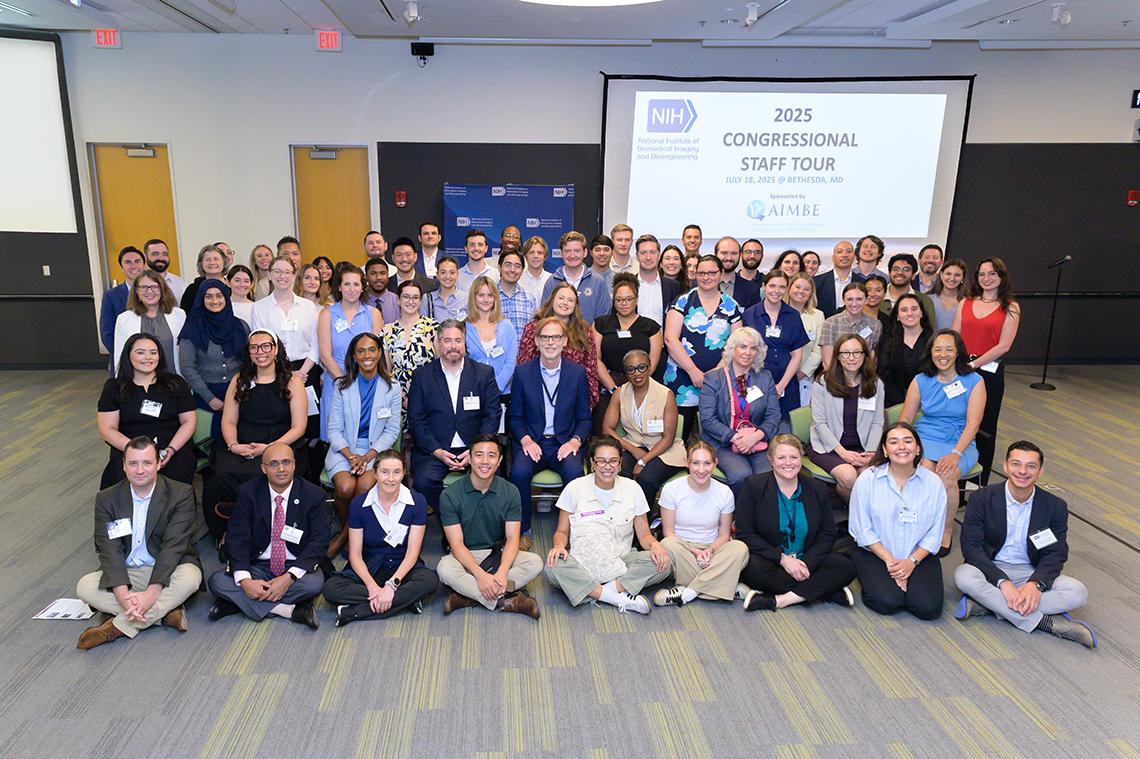
Photo: Marleen Van Den Neste
The team walked through a scenario in which the BETA Center could help clinicians fill in a birth defect in the skull, providing staffers an opportunity to get hands-on experience with 3D-printed prototype implants and hydrogels.

Photo: Marleen Van Den Neste
As the visitors prepared to depart, Tromberg harkened back to the establishment of NIBIB by Congress in 2000 and highlighted the leaps in advancement since then. In that time, hundreds of biomedical engineering programs in higher education were formed, thousands of new technologies were supported and innumerable lives were made better.
“This has been incredibly impactful. It’s something that Congress wrote with language that was so forward-looking, but it’s not over,” Tromberg said. “There’s much more to do.”
This event was organized by the American Institute for Medical and Biological Engineering (AIMBE), an advocacy group that brings together academia, industry, government and scientific societies to advance innovative, high-impact biomedical technologies.