
Advances in Neurogenetics
Bönnemann Describes Recent Breakthroughs with Patients
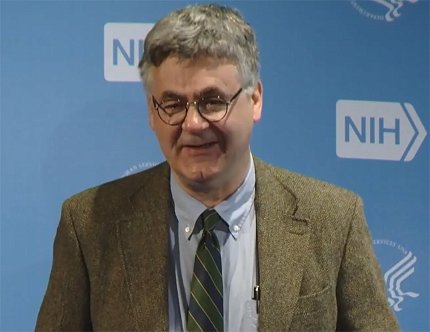
Dr. Carsten Bönnemann, a senior investigator with NIH’s National Institute of Neurological Disorders and Stroke (NINDS), studies what he calls “the neurogenetics of motion and sensation,” affecting spinal cord, muscle and motor and sensory nerves. In his Astute Clinician Lecture in Lipsett Amphitheater in December, the physician-scientist argued that medical progress is “powered by the encounter with patients.”
In his talk, Bönnemann presented three case studies of encounters with a single enigmatic patient, moving from the motor neuron to muscle and on to sensory nerves. In each, he summarized how careful observation and deep analysis led to a medical breakthrough and new therapeutic direction.
The first case he described involved a young woman with a novel genetic cause of a childhood-onset motor neuron disease. The patient had normal cognitive and sensory abilities. She developed toe-walking and stiffness in early childhood and experienced progressive muscle weakness as she grew older. By her early teens, she was unable to walk or breathe on her own.
EMG, ultrasound and muscle biopsy tests revealed that her motor neurons were dying but her sensory nerves remained unaffected. The pattern pointed to pure motor neuron disease, similar to ALS, but starting in early childhood.
Whole-exome genetic sequencing revealed a surprise: a previously unknown mutation in the SPTLC1 gene. Bönnemann noted that different variants of the gene were already known to cause the opposite disease: loss of pain and temperature sensation (i.e., sensory neuropathy) but not motor function.
After sharing his findings, Bönnemann said other doctors around the world quickly helped identify other patients with childhood-onset motor neuron disease and mutations in the same small region of the SPTLC1 gene, confirming the discovery of a new disease.
Deeper study revealed a key biochemical insight. SPTLC1 is part of a molecular machine, the SPT complex, that produces sphingolipids, essential fats used to build nerve cell membranes and nerve insulation known as myelin. The ancient pathway is tightly regulated because too little or too much production of the sphingolipids is bad.
In the case of the previously known sensory neuropathy disease, the underlying SPTLC1 mutations cause the enzyme to use the wrong substrate, producing toxic deoxy sphingolipids that damage sensory nerves.
But in the newly identified ALS-like patients, the underlying mutation caused the enzyme to produce too much of the right product in an unregulated fashion, resulting in toxicity to the motor nerves. Bönnemann said experiments using RNA-based therapies on patient cells to silence the mutant gene resulted in sphingolipid production returning to normal. The findings identified a new precision medicine therapy.
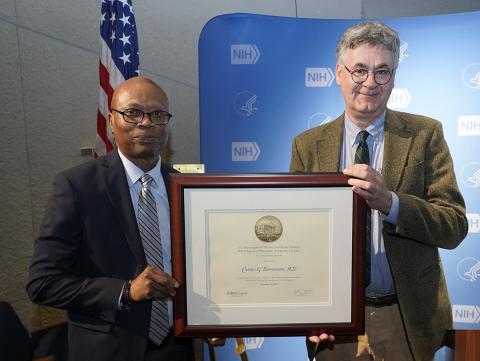
Photo: Justin Baker
In the second case study, Bönnemann described working with a patient with an unusual form of collagen VI-related muscular dystrophy.
A group of genetically inherited muscle diseases, collagen VI-related muscular dystrophies are caused by defects in the connective tissue that surrounds and supports muscle tissue. Symptoms range from mild to severe. Some patients retain the ability to walk into adulthood, while others lose that ability in childhood.
Bönnemann’s patient experienced typical symptoms of the severe form, but genetic testing did not find a genetic mutation associated with the severe forms of the disease. Only by applying RNA sequencing on muscle combined with whole genome sequencing—and guided by the clinical phenotype in collaboration with the Broad Institute—was the team able to identify a hidden mutation deep in an intron that activated a “poisonous exon” in one of the collagen VI genes causing the disease. This previously hidden mutation has now emerged as one of the most common single causes of the disease.
Because this specific mutation activates a splice event resulting in the poisonous pseudo exon to be included in the messenger RNA, it became evident that it could potentially be addressed with a precision genetic therapy to suppress the abnormal splice and revert the messenger RNA to normal. The team is taking this research toward a future clinical trial. Thus, he said, clinical recognition combined with cutting-edge genomic technology led to identifying both the cause of the disease and development of a precision therapy.
In his final case study, Bönnemann described his team’s encounter with a patient who had a complete absence of proprioception (the sense of body position in space) and specific aspects of touch sensation. Bönnemann and his team determined that loss of function of the recently discovered mechanosensory PIEZO2 was the cause of this constellation. In collaboration with NIH’s Dr. Alex Chesler, they identified and characterized more patients with this unique new syndrome.
Bönnemann went on to describe how this discovery also led to fundamental insights into the roles of mechanosensation in human sensory perception and organ functions. It also inspired development of a sensory prosthesis to overcome the loss of joint position sense by using other sensory modalities such as deep touch to relay this information to the brain.
Opening his talk, Bönnemann touched on three transformative experiences that set him on his current research path. The first was his medical school training in his native Germany, where he served a mandatory first-year summer nursing internship on a pediatric neurology ward.
The second was his work in the 1990s in the lab of Dr. Louis Kunkel at Harvard Medical School, at a time when the human genome had not yet been mapped and genetic sequencing was done by hand. There, Bönnemann helped discover the genes responsible for certain types of limb-girdle muscular dystrophy.
The final transformative experience was his recruitment to NINDS, where Bönnemann said he fully realized his “bench-to-bedside” dream: Start with a patient to identify specific symptoms and their genetic makeup; move to the lab to understand the underlying biological mechanisms; then develop precision treatments.
“I am a clinician at heart,” Bönnemann said. “I think everything we do in human medicine is powered and inspired by the encounter with our patients.”