OITE's Milgram Retires
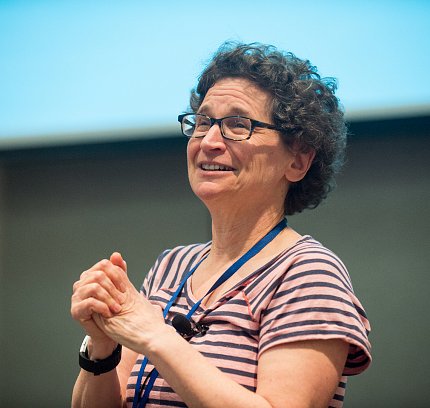
Dr. Sharon Milgram, who served as director of NIH’s Office of Intramural Training and Education (OITE) for the past 18 years, retired in December.
Milgram arrived at NIH in 2007, having just moved to the DC area from North Carolina with her research group. She came to NIH to head up a burgeoning OITE in the Office of the Director and also arrived as a principal investigator to continue her previous research. She was given a dual appointment with NIH’s National Heart, Lung and Blood Institute (NHLBI) and NIH’s National Human Genome Research Institute (NHGRI) to study protein trafficking in polarized cells, mostly airway epithelial cells, which line the lungs. Her lab, though, mainly focused on trafficking of the protein that is mutated in cystic fibrosis.
Milgram found it much harder than expected to build up and direct the then-small OITE while concurrently running a lab, so she closed her lab about five years after arriving at NIH.
When Milgram arrived, OITE did not have a career center or pre-graduate or premedical advising or well-being center. “The idea was to come with fresh eyes and to redefine what OITE could and should be,” Milgram said. “It was almost a reinventing of an office that existed.”
Much growth occurred under her leadership. Today, OITE is a vibrant office serving the entire agency, dedicated to the career advancement of more than 6,000 trainees.
“The thing I’m most proud of at NIH,” she reflected, “is the work we’ve done in the realm of well-being and mental health support, not only for our fellows but also the broader dialogue in the entire biomedical community here.”
Milgram said she’s also proud of programs OITE launched to expand opportunities for people traditionally excluded from exploring science, particularly the high school program for students from financially disadvantaged backgrounds and a program bringing community college students to the summer internship program.
“Some of those high school students and community college students are medical residents and postdocs, planning all kinds of exciting careers in research and health care,” Milgram said. “Those two programs were impactful.”
Milgram is grateful to the OITE staff who have worked tirelessly to expand services for fellows. “We really go out of our way to welcome fellows, to step in when they’re struggling, to help them grow and learn through their mistakes and despite their mistakes,” she said. “Many of the OITE staff started as fellows here.”
Looking back, Milgram said what OITE accomplished during the pandemic reflects their dedication. The staff ran postbac poster day through online presentations; a summer program fully virtual and another as hybrid with a few people on campus; programming every day so students at home were fully engaged.
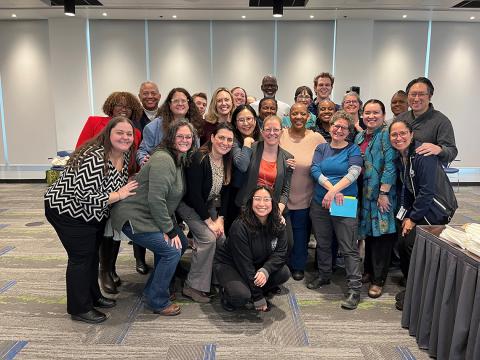
“Sharon transformed training at the NIH and across the nation,” said OITE Deputy Director Dr. Lori Conlan. “She pioneered career education over 20 years ago and built on that foundation to revolutionize well-being and resilience for the biomedical workforce. Personally, I will miss her energy, wit and joy.”
Milgram received a bachelor’s degree in physical therapy from Temple University and a Ph.D. in cell biology from Emory University. She completed postdoctoral training at the Johns Hopkins University before joining the faculty at the University of North Carolina at Chapel Hill, where she ran a research group and developed graduate programs.
At UNC, she rose to the rank of full professor in the Department of Cell & Developmental Biology. She also served as associate director of the Medical Scientist Training Program, director of the Interdisciplinary Biomedical Sciences Graduate Program and director of the Summer Undergraduate Research Experience.
“I thought a lot about training issues at Chapel Hill and then realized I was more interested in the administrative training side,” she said. “I wanted a more formal position, in that regard, and we wanted to live in a bigger city,” so NIH seemed the perfect opportunity. It turned out to be a great fit.
Upon retirement, Milgram plans to continue working to improve mentor-mentee relationships and discussing well-being with scientists.
“There’s a need for a culture change in the biomedical research community in how we engage teams and work with each other,” she said. To that end, Milgram has a longer-term goal of launching a small company that provides program development and coaching.
For now, she looks forward to more cooking and traveling. “It’s been an intense year,” she said. “Taking some time to catch my breath feels really appropriate.”
Conlan added, “I hope Sharon’s retirement is full of finding the best restaurants and taco joints that her adventures lead her to.”