Research Festival kickoff
Smell, Taste Play Important Role in Early Disease Detection
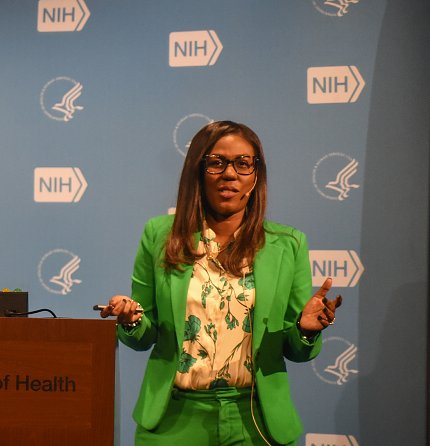
Photo: MALIK LONON
This story is the first in a series highlighting notable Research Festival lectures. The annual Research Festival is the premier event of NIH’s Intramural Research Program, featuring several days of lectures, poster sessions and workshops.
Dr. Paule Joseph’s mother-in-law is a phenomenal cook. Her pozole is unparalleled. But something changed a few years ago. The dishes coming out of her kitchen tasted extremely salty.
“At first, we laughed about it, calling her the ‘la reina de la sal,’ or the salty queen,” Joseph said during the kickoff session of the NIH Research Festival on Sept. 9 in Lipsett Amphitheater. As senior investigator and nurse practitioner at NIH’s National Institute on Alcohol Abuse and Alcoholism with a joint appointment at NIH’s National Institute on Deafness and Other Communication Disorders, and co-director of NIH’s National Smell and Taste Center, Joseph knew this change could mean a lot more.
Joseph tested her mother-in-law’s smell. Sure enough, it was diminished. Further medical tests revealed a frontal temporal lobe dementia diagnosis.
“The more we research smell and taste and integrate them into clinical care, the greater healing becomes possible for more and more people,” said Joseph. “We can build a future where sensory science is not an afterthought, but a foundational piece of how we understand health.”
That extra pinch of salt was an early warning sign. Loss of smell is a common symptom in many patients with other neurodegenerative diseases, such as Alzheimer’s and Parkinson’s, and may occur several years before motor and cognitive symptoms develop.
“Smell and taste are among our most ancient senses,” Joseph said. Smell works when airborne molecules enter the nose and activate olfactory receptors in the olfactory epithelium, sending signals to areas of the brain involved in emotion, memory and survival.
“That’s why a single whiff can instantly transport us to a childhood memory or shift our mood without warning,” Joseph said. “These senses aren’t just about smelling of fragrance or detecting flavor. They are fundamental to how the brain tracks the world. When we overlook them, we risk missing important information.”
At NIH, Joseph leads a lab that studies how diseases affect taste and smell and how these senses are connected to metabolism, addiction, brain health and overall quality of life. She conducts her research at the NIH Clinical Center, where she said, “curiosity and collaboration are not just virtues, but imperatives.”
Photo: MALIK LONON
Before 2020, many doctors dismissed the loss of smell and taste in their patients, she said. It was often viewed as a curiosity or lifestyle concern. Clinicians also lacked the tools to screen, diagnose and track smell and taste loss.
During the early days of the Covid-19 pandemic, people reported losing their sense of smell. Researchers discovered that losing taste and smell is an early symptom of infection. It turned out that an estimated 60% of patients experienced smell loss in early phases. In addition, loss of the senses of smell and taste are among more than 200 different symptoms reported by people with long Covid. “What started with patients telling us ‘I can’t smell my coffee’ became an actionable clinical clue,” she said.
Joseph and her colleagues were able to learn more about the loss of smell due to support from NIH’s Intramural Research Program. They had been conducting basic research on smell and taste years before the pandemic began.
Joseph also studies how alcohol addiction alters smell and taste. Her lab has found that heavy drinkers have a weaker sense of smell. “That loss wasn’t trivial,” she said. “It was tied to declines in their health, mood and social lives.”
Photo: MALIK LONON
In a follow-up study, Joseph discovered people who drank heavily sensed differently. They were less able to taste bitter compounds and more tuned to sweet smells. Additionally, they were less likely to notice danger cues, such as the smell of natural gas. Alcohol rewires the brain, she said, “toward reward and away from risk.”
Joseph dreams of a future where doctors and other healthcare professionals measure smell and taste along with a patient’s other vital signs. By tracking how these senses change over time, doctors can recognize conditions early.
Joseph did not ignore her mother-in-law’s change in cooking, altered taste and diminished sense of smell. Because of that, she got an early diagnosis. This extra time gave her the opportunity to prepare and plan for her mother-in-law’s care.
“I’m working to write down my mother-in-law’s pozole recipe,” she said. “I get to stand side by side with her in the kitchen, knowing this time is precious. This gift of early detection is only possible because of research.”