
Hyde and Seek
Filpula’s New Book Turns Biochemistry into Poetry
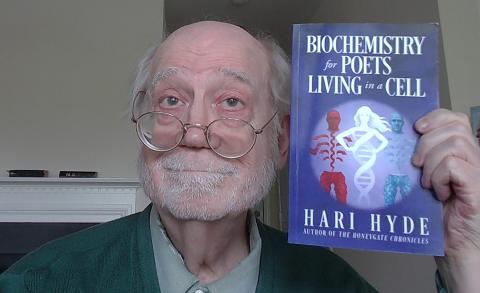
Different molecules perform essential functions in our bodies. As these proteins, lipids, nucleic acids and other biomolecules go about their work, they can have reactions, adapt, bond, be spontaneous—among their many traits reminiscent of human behaviors.
Inspired by this idea, NIH’s Dr. David Filpula made biomolecules characters in his latest book, titled, Biochemistry for Poets Living in a Cell.
Filpula, an NIH scientific review officer for the past 14 years, is a biochemist who loves literature, particularly fables and poetry. He has published several books over the past decade under the pseudonym Hari Hyde, though his latest book, published last summer, is the one most tightly connected to science.
“The urge struck me less than a year ago to combine my knowledge of biochemistry with my love of poetry,” he said. His new book is a collection of 70 tales.
“I explain complex biochemistry concepts using biomolecules, who are now characters in the cell, having personalities, motives and emotions,” Filpula said. “Whereas a biochemistry text would provide a descriptive report, my book humanizes these biomolecules, portraying them as characters with actions and voices…These molecules are such easy metaphors for human behaviors.”
There are hero proteins, traitorous viruses and enzymes that are militant maniacs. Sometimes the molecules ponder their mysterious environment, namely the human. In one chapter, “The Unanswered Question,” a biomolecule gazes outside the cell membrane, hearing the thump of the heart and thinking, “why are things this way?”
Another vignette, “Auntie’s Pet Protein,” introduces a woman who loses her dog, Marley, and decides she wants a better-behaved, less-mischievous pet. Her nephew convinces her to adopt the biggest protein in her heart, named Titin. He’s very obedient and they get along but, after a while, she comes to miss Marley’s rebellious nature.
Yet another tale, “L-asparaginase: Juggler in Bondage” is based on an enzyme Filpula studied during his previous 30-year career in the biotech industry. Some cancer cells lose their ability to make the amino acid asparagine, Filpula explained. Scientists had discovered that adding the bacterial enzyme L-asparaginase to a cancer culture stops cancer cells from growing because they require external asparagine. The enzyme eventually became a useful drug.
“I tell the story from the perspective of the enzyme, who is very annoyed and put upon because he is taken away from his happy home in E. coli, where he came from, to go into the human bloodstream and have to, basically, serve in a foreign army,” Filpula said. “So I describe his adventures and regrets in doing that.”
During Filpula’s years working for biotech companies, he’d collaborated several times with NIH scientists. “I had a lot of great memories of NIH and developed a love for the institution before I even joined,” he recounted. “When I joined NIH’s Center for Scientific Review (CSR) in 2011, it was my final stop.” He’d found his happy home.
When Filpula became an author, he wanted to keep his day job and writing hobby separate so he decided to take on a pseudonym. One day, while looking in the mirror at his scruffy face, he thought to himself, “You look like a ball of hairy hide.” That was it! He changed the spelling to Hari Hyde and his pseudonym was born.
Through his latest book, Filpula seeks to engage the imagination of readers, bringing them on a journey where they experience the events alongside the characters. He hopes the scientist and non-scientist alike will connect to these stories on an emotional level, because everyone loves a good story.
“I want to be entertaining,” he said, “and I want readers to learn something.”