NIH Labs Compete in the Freezer Challenge

Since its inception in 2017, the Freezer Challenge has encouraged labs to reduce energy consumption, which reduces operating costs and environmental impact. While some participating researchers have received awards, all participants have attained better sample management and more reliable equipment.
Each year, thousands of labs from government organizations, universities and private companies compete to see who can reduce the most energy consumed by the freezers in their labs. The challenge, co-hosted by My Green Lab and the International Institute for Sustainable Laboratories, is held from January through June.
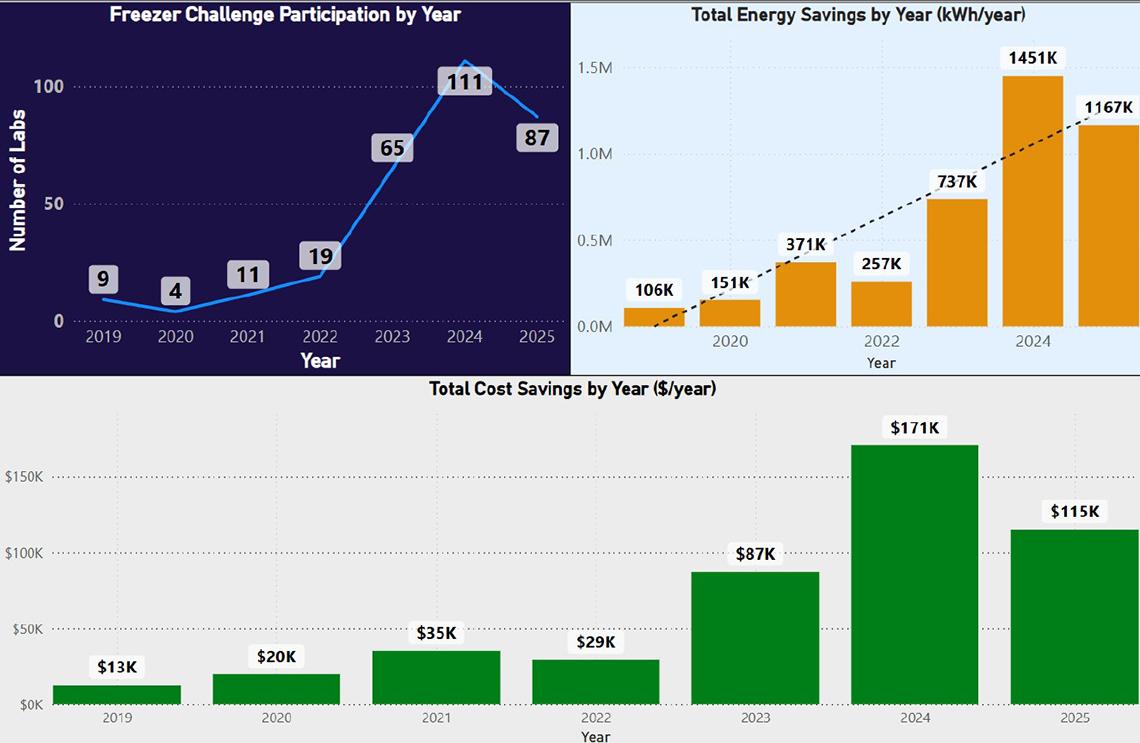
This year, 87 labs participated in the NIH Freezer Challenge. Their combined efforts reduced energy consumption by more than 1,100,00 kWh, conserved 856 MTCO2e in greenhouse gas emissions and saved more than $115,000 this year alone. There are thousands of freezers in service at NIH, yet this feat was accomplished by 87 labs. These results show the power each lab has to increase freezer reliability while also protecting the environment.
The total costs and emissions from cold storage equipment is significant. Mechanical Ultra-Low Temperature (ULT) freezers are among the most energy-intensive pieces of laboratory equipment. Older, unmaintained ULT freezers can be especially costly.
Challenge initiatives ranged from maintenance options, such as defrosting freezers, to laboratory best-management practices, such as changing the temperature setting of ULT freezers. Changing the temperature from -80°C to -70°C reduces the amount of work the compressor does, which increases freezer reliability and reduces energy consumption by about 30%.
Within NIH, the National Institute of Environmental Health Sciences (NIEHS) boasted the most submissions with 21 labs participating. The National Center for Advancing Translational Sciences (NCATS) came in second with 12 submissions, and the National Heart, Lung and Blood Institute (NHLBI) came in third with 10.
For more information, see: go.nih.gov/EooZTQt.