NIH Mourns the Passing of Biochemist Matthaei

Dr. Johann Heinrich Matthaei, an esteemed German biochemist and former NIH postdoctoral researcher, passed away on July 7 in Göttingen, Germany at age 96.
From 1960 to 1962, Matthaei was a fellow at NIH where he conceived and executed the seminal “polyU” experiment alongside Dr. Marshall Nirenberg. Beginning on May 15, 1961, Matthaei showed that polyuracil directs the synthesis of polyphenylalanine, proving that UUU is the codon for phenylalanine—cracking the first element of the genetic code. Published in the Proceedings of the National Academy of Sciences (PNAS) later that year, these results propelled the decoding of the remaining codons by 1966.
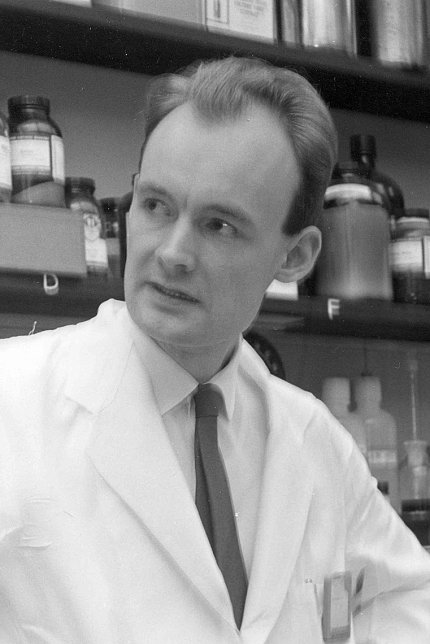
This foundational work, led by Nirenberg, paved the way for decoding the language of DNA and ultimately led to Nirenberg’s 1968 Nobel Prize. Matthaei acknowledged it “pained” him not to be included in that Nobel Prize, yet he remained undeterred.
Returning to his native Germany in 1963, he became director of molecular genetics at the Max Planck Institute for Experimental Medicine in Göttingen, mentored numerous doctoral students, completed his habilitation in 1966 and, until late in life, lectured for the Studienstiftung des Deutschen Volkes (German Academic Scholarship Foundation). In a message to the NIH Record, his son Albrecht wrote, “My father’s time at NIH meant a great deal to him. Until his death, he enjoyed talking about his research stay in Maryland.”
His lifelong curiosity and passion for research endured to the end.