“John, we have an emergency”
Burklow Recounts Pivotal Moments in Recent NIH History
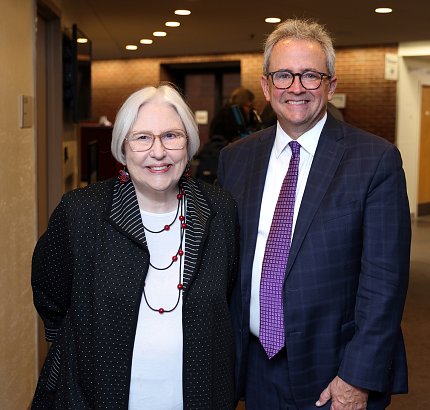
Photo: Chia-Chi Charlie Chang
When faced with an unprecedented situation that could quickly devolve if mismanaged, it’s essential to have a point person who can act decisively and remain calm under pressure. For 25 years, John Burklow was that person guiding NIH directors through many thorny issues—often infusing a little humor in the process.
Currently, Burklow is a senior vice president at the Foundation for the NIH, where he also serves as chief strategic communications and engagement officer. He first arrived at NIH nearly 40 years ago as an intern, then rose through the ranks to head NIH communications and ultimately serve as NIH’s chief of staff.
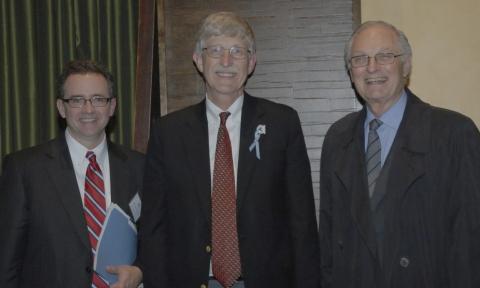
For decades at NIH, Burklow had a front-row seat to—and played an active role in planning—major events while mitigating challenges. He shared his observations of some of these key moments at the NIH Research Festival on Sept. 10, where he delivered the Victoria Harden lecture in NIH history.
Throughout his tenure, he has seen NIH budgets rise and fall, even through strong bipartisan support for the agency.
One divisive issue, though, that Burklow called “a narrow political minefield” is the use of human embryonic stem cells (hESC) in research. Starting in 2000, the debate over whether hESC research was immoral or pioneering dominated the news. In May 2002, incoming NIH Director Dr. Elias Zerhouni chose his words carefully. Burklow recalled, “Elias had to walk a fine line between supporting the science and not alienating the [U.S.] president, who was his boss.”
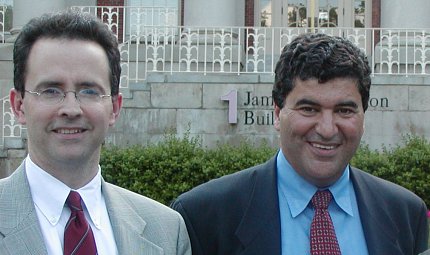
Five years later, Zerhouni testified before the Senate that the president’s stem cell policy impeded the momentum of science, as Burklow subsequently fielded media queries. The issue kept NIH on pins and needles for almost a decade.
“The saga illustrated to me in a profound way all the audiences paying attention to NIH—the media, Congress, the White House, professional societies, patient groups and industry,” Burklow said. “It also changed the status of NIH in Washington. The agency was seen as a major player…in the center of a red-hot political issue.”
Another development during that time, Burklow noted, “literally changed the face of NIH and its relationship with its neighbors.” After 9/11, NIH began erecting a perimeter fence around its 300+ acre Bethesda campus. Once completed, the fence changed the atmosphere, preventing anyone from openly traversing campus grounds.
“The fence also created an impression that dangerous, top-secret research was being conducted on campus,” Burklow observed, though the true objective was to keep NIH staff and patients safe. Meanwhile, much to his chagrin, the fence and many security checkpoints inadvertently kept VIPs out, no matter how much they prepared for these visits. The fence, he said, became a lasting reminder of the new normal.
In fall 2003, a homegrown controversy erupted when a series of newspaper articles exposed conflicts of interest at NIH. Some intramural scientists, including some top leaders, were leveraging government work for private gain.
“Seven painful, embarrassing House oversight hearings over the following months revealed improprieties Dr. Zerhouni found impossible to defend,” Burklow recalled. He and his colleagues prepared the director for those hearings and, while comprehensive in gathering data, the committee staffers countered with incriminating evidence they’d collected directly from the companies.
While some high-profile scientists quit, the controversy inspired a much-needed overhaul of NIH’s ethics program. “It was a bumpy cultural shift,” Burklow said. “Clearly, the scandal and fixes that followed profoundly changed the culture of NIH and what was considered acceptable behavior.”
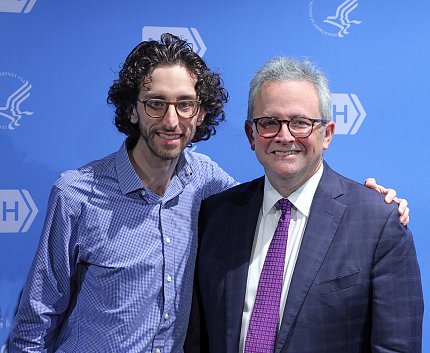
Photo: Chia-Chi Charlie Chang
A decade later, there was a shocking discovery on the Bethesda campus. As staff were relocating from Bldg. 29A, they discovered a box in a cold storage room dated 1954. Inside were six vials of smallpox, two of which contained live virus. Smallpox was eradicated in 1980 after an extensive global vaccination effort, making this discovery especially unsettling. What’s more, staff found more than 300 vials of other pathogens.
This got everyone’s attention, noted Burklow—HHS, the White House, Congress, local government, the State Department, FBI, World Health Organization—to name a few. Meanwhile, NIH staff were upset they weren’t notified before this incident hit the news.
“That was a lesson I’ll never forget and a mistake we tried never to repeat,” Burklow said. “Always overcommunicate in a crisis.”
Subsequently, every freezer and storage room on campus was subject to an inventory. Following the investigation, countless hours were spent reconceiving all policies and procedures related to select agents and pathogens, which ultimately changed the safety culture at NIH.
The final recollection Burklow shared was not a singular event but an outreach strategy—the effort to invite influential people to NIH from different fields. Over the past 15 years, NIH welcomed actors, musicians and artists among its high-profile visitors who toured, lectured and engaged with researchers.
Burklow recalled the many months of advance work prior to the visit of His Holiness the Dalai Lama in 2014 and yet nothing prepared him for a last-minute surprise that morning. The State Department asked Burklow to accommodate 800 Tibetans who wanted to meet His Holiness. Meanwhile, the 1,000 NIH ticket-holders would soon be in line outside the Natcher Conference Center.
Burklow figured it out. He worked with NIH Police to get the Tibetans through security. They entered on one side, met with His Holiness, and then NIH staff—perplexed at the long delay—entered through the opposite entrance.
“It was the most daunting logistical challenge I ever encountered in my tenure at NIH, but what a historic event,” Burklow said.
Looking back on his tenure, Burklow noted the high expectations and increased scrutiny that came along with NIH’s increased visibility.
“Blind spots in any organization tend to develop slowly, insidiously, and are very difficult to recognize and accept,” he said. “It usually takes a crisis to bring about a new perspective.”
Some crises were internal, others a response to outside factors.
“For NIH, the challenge for the agency was to acknowledge the problems and take decisive action, sometimes unpopular action, necessary to remedy the problem and preserve the integrity and reputation of the institution.”
Through the ups and downs and culture shifts, NIH staff have continued to grow more resilient, Burklow noted. He hopes when future historians look back on these times, “they also study the degree to which NIH nurtured its most vital resource and key ingredient to its success—the people who work here.”