NCI Biochemist Kimura Retires
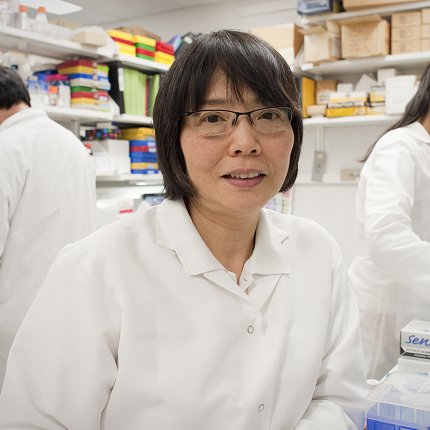
Dr. Shioko Kimura, a biochemist at NIH’s National Cancer Institute (NCI) who specializes in endocrinology, retired in June after an almost 40-year career at NIH. She studied how certain genes and proteins work in the thyroid gland and the lungs, both when they are healthy and diseased.
Kimura’s research focused on the NKX2-1 gene, which acts as a master switch that controls many other important genes in the thyroid and the lungs. Her team was the first to identify and clone the gene, and they demonstrated how the encoded homeobox transcription factor protein NKX2-1 is crucial for development, homeostasis, function, physiology and disease pathogenesis including cancer of the brain, thyroid and/or lung.
Over the course of her career, Kimura provided extensive service to the scientific community by sitting on editorial boards, editing and reviewing for a variety of journals and grants, and participating on numerous NIH and NCI committees. Her dedication to some of these activities spans more than a decade. At NIH, Kimura has been particularly involved with committees to advance women and Asian American and Pacific Islander researchers in science and workplace civility practices. In 2021, she received the NIH Director’s Award as part of the CCR Women Scientist Advisors.
Kimura received her Ph.D. in chemistry at Hokkaido University in Sapporo, Japan in 1979. After completing a postdoctoral fellowship at Queen’s University in Kingston, Canada, she joined NIH as a visiting fellow at NIH’s Eunice Kennedy Shriver National Institute of Child Health and Human Development. In 1986, she moved to NCI as a visiting associate scientist in the Laboratory of Molecular Carcinogenesis. She became a senior investigator in 1998 in the Laboratory of Metabolism, which eventually became the Cancer Innovation Laboratory in 2022.
In retirement, Kimura plans to continue working as a special volunteer to help compile data and prepare manuscripts of some of her postdocs and postbacs who recently left NIH. This is critical for their future careers, she noted. She also said she hopes her work with a local biotech company will bring SCGB3A2 closer to development as a therapeutic in treating lung diseases.
First, though, she said, “I’d like to relax a little after decades of intense research in the NCI and spend some time in my hometown in northern Japan.”
To learn more about Kimura’s research, see this Q&A on NCI’s website: https://go.nih.gov/GguTRI0.