Honoring the Healing Totem Pole’s Legacy at NLM
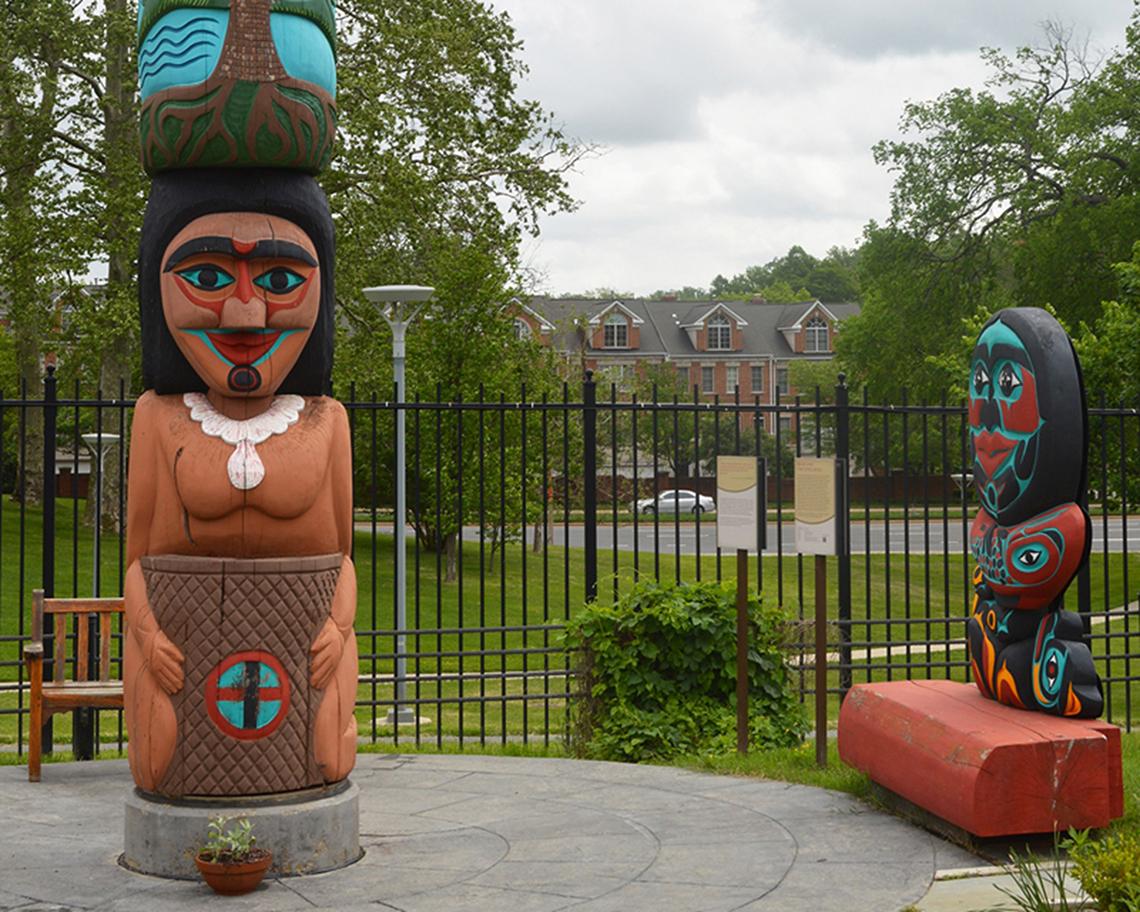
In 2011, a striking new addition appeared in the heart of the National Library of Medicine (NLM) grounds: a hand-carved, brightly painted healing totem pole, flanked by carved benches. It quickly became a focal point of the NLM herb garden—an artistic landmark and a spiritual presence that drew admiration and reflection from staff and visitors alike.
The healing totem pole’s story began with a vision to celebrate Native American heritage and honor the vital role of tribal communities in advancing medicine, healing and health—and the deep interconnectedness of wellness, illness and cultural life across generations.
Commissioned by NLM, the totem pole was carved by master carver Jewell Praying Wolf James, a member of the House of Tears Carvers of the Lummi Indian Nation in Bellingham, Washington. Each figure carved into the wood—from the sky, the earth and water—represents a story, a lineage and a connection between people, land and spirit.
The healing totem was installed with great care and meaning near the NLM herb garden, a space dedicated to healing plants and traditional knowledge, offering a powerful connection between culture and medicine. Made from red cedar—a wood chosen for its significance and traditional use—the healing totem pole was always intended to return to the earth, following the cycle of life and renewal that is central to many Indigenous worldviews.
After nearly 14 years standing tall in the sun, wind, rain and snow, the healing totem pole and accompanying benches have reached an advanced stage of natural decay. Unfortunately, the rate of deterioration has accelerated in recent years. Safety assessments have determined the structure now poses a risk to staff and visitors who enjoy the NLM herb garden.
Rather than preserving or relocating the structure, NLM has decided to gently retire the healing totem pole and carved benches to an area adjacent to the garden. The healing totem will be allowed to decay naturally and return to the Earth—a practice rooted in the belief that totems, like all living things, are part of a greater cycle.
This process will be carried out with care, and the approach aligns with the values expressed by the carvers themselves when the healing totem pole was first raised and echoes the spirit of the NLM herb garden it has graced for more than a decade.
While the physical healing totem may return to nature, its legacy will remain part of NLM’s story. Photographs, stories and historical materials will continue to be preserved as part of NIH’s institutional memory and archives.
This healing totem pole has served as more than a work of art—it has been a symbol of healing, partnership and respect. As we say farewell, we do so with gratitude for the stories it told and the space it held.