NCI Radiation Biologist Retires
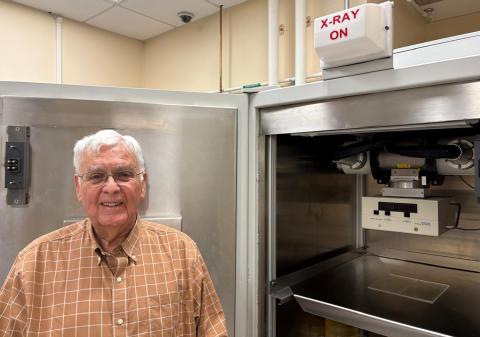
Dr. James (Jim) B. Mitchell, a radiation biologist at NIH’s National Cancer Institute (NCI), retired after nearly 50 years. His research focused on evaluating agents in combination with radiation that either enhance tumor sensitivity or protect normal tissues. His work has been vital in helping physicians and researchers understand how to safely treat cancer with radiation therapy.
Mitchell is originally from Tennessee. He completed his bachelor’s degree at Austin Peay State University, master’s degree at George Peabody College and a Ph.D. in cellular radiation biology from Colorado State University. Mitchell’s earliest work on dose-rate effects of radiation-induced cell killing fulfilled a need for physicians to understand the sensitivity of human tumor cells to a variety of novel agents.
His work was centered on the radiobiology of low-dose radiation and differences in the cellular response to low-dose versus high-dose radiation. His findings over the years continue to be extremely relevant to modern-day brachytherapy (localized radiation therapy). Mitchell went on to spearhead efforts related to establishing dosage safety and administration schedules for radiation treatments. Many of these are still being employed in the clinic to treat patients today.
Shortly after earning his doctorate, Mitchell joined NCI’s Radiation Oncology Branch and became a principal investigator. He eventually came to serve as chief of NCI’s Radiation Biology Branch for more than 30 years.
Mitchell’s laboratory was the first to identify nitroxides as catalytic antioxidants with protective properties against radiation damage. He was involved in developing photodynamic therapy for clinical cancer treatment at NCI, a program still active at the University of Pennsylvania. Recently, he published a study demonstrating that mice exposed to total body radiation of 3 Gy and rapamycin placed in their food after radiation results in less carcinogenesis.
“Dr. Mitchell has a strong track record of having multiple lab findings implemented in the clinic to improve the efficacy of radiotherapy in treating tumors as well as protection of normal tissue during radiotherapy,” said Dr. Murali Krishna Cherukuri, senior investigator in the Radiation Biology Branch. “More than three decades ago, he recognized the importance of tumor microenvironment in the outcomes of cancer treatment and the critical need of molecular imaging techniques to profile the tumor physiology and metabolic status. His involvement in this field made the CCR Radiation Biology Branch one of a small group of labs in the world with unique preclinical imaging capabilities, some of which have been translated to clinic.”
Mitchell has been a member of the American Society for Therapeutic Radiology and Oncology and the American Association for Cancer Research for almost 40 years.
Another noteworthy accomplishment, Mitchell and his colleague Dr. John Cook taught a full 30-hour radiation biology course to residents in the Radiation Oncology Branch. This was conducted from 1980 to 2020 for 95 residents.
“Dr. Mitchell is a true legend in the field of radiobiology,” said Dr. Deborah Citrin, senior investigator at NCI and a longtime colleague. “Beyond the scientific accolades and countless honors and awards, Dr. Mitchell is one of the most caring and dedicated mentors I have ever met…His career and contributions have been nothing short of remarkable.”