
Genomic Sequencing Reveals Complexity of Microbial World
The microbial world encompasses a vast array of undiscovered microorganisms that live in many different ecosystems, including some of the harshest environments on Earth.
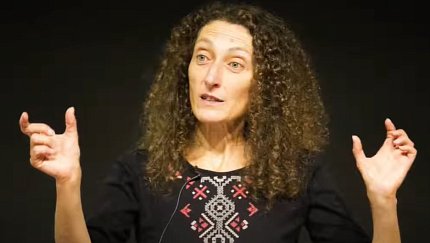
Scientists now have a wide variety of genomic sequencing tools to identify and gain insights into their past, said Dr. Purificación López-García, research director in the ecology, systematics and evolution unit at the French National Centre for Scientific Research. She spoke at an NIH Director’s Wednesday Afternoon Lecture Series (WALS) talk earlier this summer in Lipsett Amphitheatre.
These advances allow scientists to reconstruct the evolutionary relationships of all life on Earth through genetic information. The relationships are often depicted as phylogenetic trees, which are branching diagrams that show how species or groups of organisms have diverged from each other over time. The trees illustrate how species are related through a common ancestor. If two organisms branch off from the same node, it’s thought they evolved from the same ancestor.
There are three domains of life: archaea, bacteria and eukaryotes. Archaea and bacteria are prokaryotes, meaning they are single-cell organisms that don’t contain a nucleus or other membrane-bound organelles. All organisms whose cells contain a nucleus and other membrane-bound organelles are eukaryotes.
López-García and her team travel the world searching for new lineages of these domains. They’ve taken samples from the deep-sea floor, volcanic hot springs and crater lakes. The more they learn about these lineages, the greater detail they can add to phylogenetic trees.
Bacteria make up most of the microbes on the planet. She studies one group of bacteria called the Candidate Phyla Radiation (CPR). These bacteria have small genomes and depend on other microbes to obtain many essential cellular components to survive.
“CPR bacteria have an important ecological role in controlling the host population size of other bacteria,” López-García said.
CPR bacteria are found in a variety of ecosystems, she said. They prefer oxygen-poor environments and are particularly abundant in subsurface aquifers, sediment and soil.
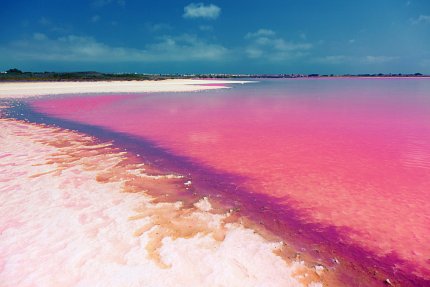
Photo: Victor Zastolskiy/Shutterstock
The existence of this group was first discovered in the 1980’s. Back then, two scientists were studying microbes in a tiny lake in Catalonia, Spain. Each year, the lake turns a pinkish-purplish color for several months. A microorganism belonging to the purple sulfur bacteria is responsible for the color change.
The scientists took a sample from the lake and observed it under a microscope. They saw smaller bacteria latch onto the purple sulfur bacteria and suck out the cell’s components. They named the bacteria Vampirococcus after the mythical creature that feeds on the living. This was the first time anyone had observed a bacteria exhibiting this kind of predatory behavior.
More than 30 years later, López-García and her team collected samples from microbial mats from another lake in Spain. The mats contained a type of bacteria that could photosynthesize without producing oxygen. They placed what they brought into tanks in the lab.
A few days later, the bacteria bloomed. They looked at the bacteria under a microscope and, in addition to bacteria that caused the bloom, they found another microbe—one that resembled Vampirococcus. They collected the newly discovered bacteria and a genomic analysis revealed the bacteria was also part of the CPR group. They named their discovery Vampirococcus lugosii after Bela Lugosi, the actor who played Dracula in the 1931 film of the same name.
“Vampirococcus is violent. It terminates the bloom of its host rapidly,” López-García said.
They since discovered more members of the CPR bacteria group. These findings have allowed them to learn more about the bacteria’s biology and mechanisms of action.
López-García’s research is also revealing important clues about archaea’s evolutionary history. Archaea were initially grouped with bacteria due to their size and shape. In the 1970s, the biologist Carl R. Woese discovered that archaea have genetic and biochemical differences, which justified their classification as an independent domain of life.
At first, there were two groups of archaea known. “We now recognize four major groups of archaea,” she said.
Archaea are well known for their ability to live in the world’s most inhospitable places. Different groups have adaptations to survive. They can, for instance, tolerate high concentrations of salt, scalding temperatures and acidic conditions.
Some archaea maintain symbiotic relationships with other microorganisms, she said. Their living conditions influence whether they are mutualistic, parasitic or possibly commensal.
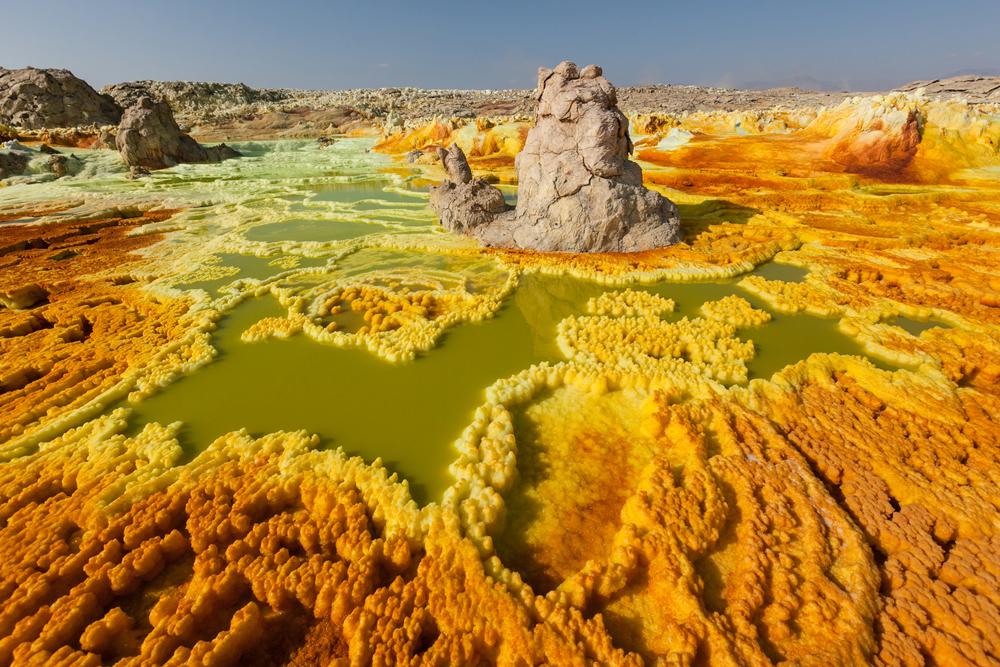
Photo: KATJA TSVETKOVA/SHUTTERSTOCK
To learn more about the types of archaea that live in these extreme ecosystems, López-García collected samples from the Danakil depression in northeast Ethiopia. Sitting at the intersection of three tectonic plates, the depression is a volcanically active region that sits below sea level. It’s home to hot springs and lava lakes. Due to its thick salt, deposits coat the depression’s bottom.
An analysis of samples taken from hypersaline lakes found that most of the microorganisms living in these salty ecosystems were halophilic archaea. Halophilic describes organisms that thrive in high-salt environments. Her lab also discovered new lineages of halophilic archaea.
Genomic analyses of these organisms have revealed “there are at least four independent adaptations to extreme halophily in archaea,” she said.
The phylogenetic information gathered from these samples allows them to produce more and better data to better understand the evolution of archaea that’s providing clues to the domain’s origin.
López-García is also using genomic information to fill out the phylogenetic tree for eukaryotes, the vast majority of which are unicellular. Only a few of them gave rise to multicellular organisms at some point in their evolutionary history.
Eukaryotes come in many shapes and sizes, so scientists thought they “more or less knew all of the big groups.” But genomic sequencing is revealing new lineages.
The inclusion of these lineages into the phylogenetic tree is shifting scientists’ views about eukaryogenesis, the process by which the eukaryotic cell and lineage evolved. López-García posited that the first eukaryotic cells were the result of a symbiotic relationship between an archaeon and at least a bacterium (her syntrophy hypothesis proposes two bacteria involved), where the metabolic products of one partner were used by the other. Her hypothesis is just one of several about how the process occurred. Many open questions remain about how eukaryogenesis took place.
López-García concluded, discovering the origins of eukaryotes “can only be done by integrating these different aspects of the diversity ecology and evolution of microorganisms that have populated the planet for most of the history of the Earth and still dominate today.”