NIH Mourns the Passing of Prominent Retrovirologist
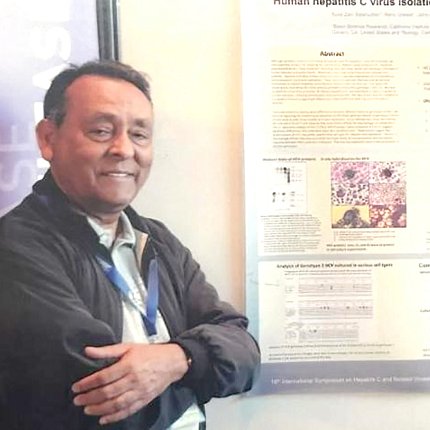
Dr. Syed Zaki Salahuddin, who closely collaborated with Dr. Robert Gallo at NIH on his groundbreaking studies of human immunodeficiency virus (HIV), died on July 8 in Ventura, Calif. He was 84 years old.
Salahuddin, born in pre-independence India, graduated from the University of Dacca (now in Bangladesh, then East Pakistan). He then moved to the United States to gain research experience. Salahuddin worked at Walter Reed Army Medical Center before joining Gallo’s research team at NIH. He quickly established himself as one of the leading retrovirologists in the country.
It is hard to imagine today how much fear the emergence of an unknown pandemic caused in the early 80s, mainly affecting young men, and almost always being fatal. Physicians and epidemiologists observed that all patients experienced a catastrophic breakdown of their immune systems.
A fierce race among virologists worldwide ensued to identify the cause. French scientists, led by Montagnier at the Pasteur Institute, isolated a new retrovirus from AIDS patients in 1983 and named it Lymphadenopathy-associated virus (LAV), which was later proven to be the cause of AIDS.
At NIH, on Gallo’s team, Salahuddin also reported the identification in 1984 of a virus, HTLV III, that caused AIDS. The controversy over which laboratory should be credited with the discovery was resolved when it was demonstrated that the viruses isolated by the two laboratories were identical. A neutral name, HIV, was adopted.
Salahuddin’s other research concentrated on human herpesvirus 6 (HHV-6). His numerous publications on HHV-6 and similar viruses helped clarify their roles in various clinical scenarios, including AIDS and other viral infections.
Salahuddin left NIH in the late 1980s and moved to California, where he founded the California Institute of Molecular Research. In his free time, he pursued painting as a hobby. Later in life, he rediscovered his spiritual heritage and began regularly attending religious services at a mosque in Ventura.
—Syed Amir, who retired from NIH’s Center for Scientific Review in 2010